Playfair 1.0.0 Release

In the meantime, a lot has happened and the release of Playfair 1.0.0 was forgotten. We would like to make up for this omission and briefly present the highlights of the release.
Thoughts on agile software development
In the meantime, a lot has happened and the release of Playfair 1.0.0 was forgotten. We would like to make up for this omission and briefly present the highlights of the release.

If you want to interpret a programming language or a DSL, there’s no way around using a parser generator. At the heart of FreshMarker is a template parser generated by the CongoCC parser generator. I can’t praise this JavaCC successor from Jon Revusky highly enough. Many new features and completely revised parts make the parser generator much more usable than its seemingly dead predecessor. CongoCC also helps wonderfully with a small current problem.

Just in time for Carneval there is a new FreshMarker release available. There are several enhancements to the built-ins through the addition of an easy lambda support.

To implement a new built-in for sequences, lambdas were added as a new language component of the FreshMarker Expression Language. The lambda expression made it much easier to map the semantics of the new count built-in in an easily readable syntax. Now that lambda expressions are available, what else can they be used for and what still needs to be implemented?
In the first article on the Select Operator, the implementation was provisionally terminated with a few weaknesses. In this article, two of the weaknesses are eliminated.
An important component of the FreshMarker template engine is the built-in expression language. The expression language is used to utilize not only variables but also complex expressions in directives and interpolations. When evaluating other expression languages for customer projects, sometimes I am interested in integrating some findings into the FreshMarker expression language.

Just in time for St. Nicholas Day, the latest FreshMarker release for this year is now available. In addition to several improvements, two bugs have also been fixed.
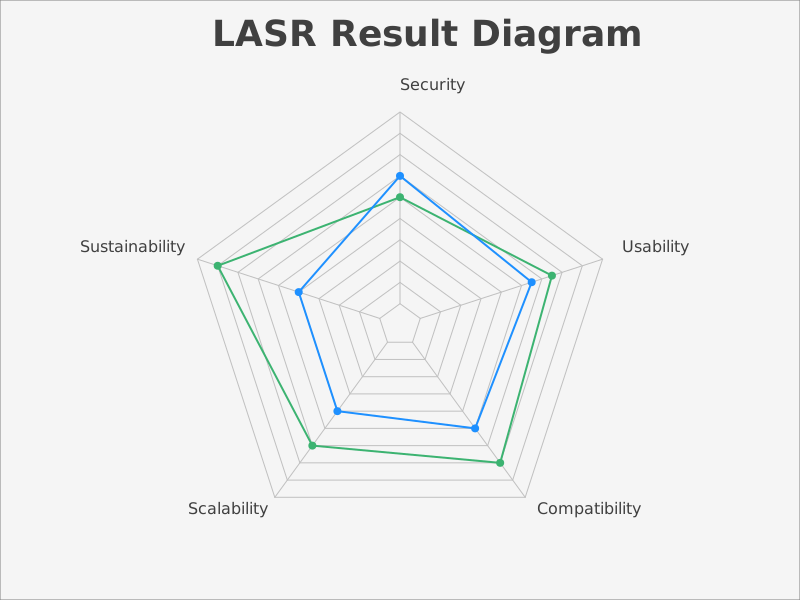
Spider charts, also known as radar charts, are among the most versatile tools for data visualization. These circular charts make it possible to display multiple variables simultaneously and present complex data sets in an intuitive form. They are particularly valuable for analyzing performance indicators, evaluations, or comparisons between different objects or time periods. Wouldn’t it be nice to have Playfair generate spider charts?

You may have noticed that the Playfair project started with the JFreeSVG library and has now switched to the EchoSVG library. Both libraries have their advantages and disadvantages, but JFreeSVG’s GPL 3.0 license in particular makes working with it difficult in many projects, often even impossible. With the next version 0.7.0, Playfair will switch to the Apache 2.0 license. This would be a little too little content for a blog post, so let’s take a look at one of EchoSVG’s weaknesses.
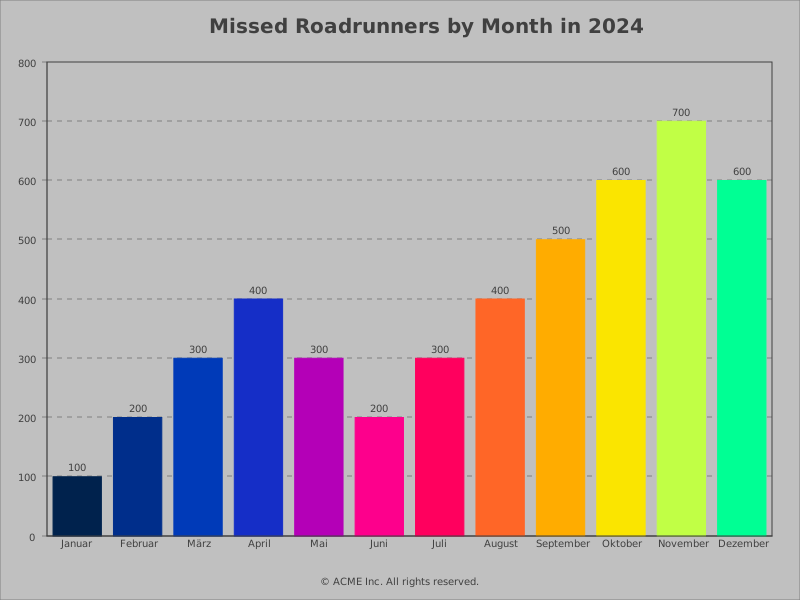
While searching for a name for the new project, I looked up the inventor of charts for fun. I was amazed to find that this person actually existed. William Playfair (born September 22, 1759, near Dundee, Scotland; † February 11, 1823 in Covent Garden, London, England) is a pioneer of information graphics and is considered the inventor of bar and pie charts. What an unexpected opportunity to honor this man. The name also fits perfectly with an open source project that aims to provide simple charts without a lot of fuss. This article shows what has changed since the first bar chart and how much Java takes off our hands.